



Matching pet cans, easy-open ends, and seamers works as one system: approved drawings first, then a trial run. Mismatched orders bring line downtime, rejected ends, and wasted inventory. This post gives a step-by-step process and a supplier checklist. Use it to confirm PET can lid compatibility before you order a single pet can.
★ Key Takeaways
- ✓ Always request and check approved drawings for the can body and easy-open end before ordering.
- ✓ Run a trial seam inspection with your actual product and seaming equipment to confirm compatibility.
- ✓ Use a complete order checklist and record all confirmations to ensure repeat orders stay consistent.
Body and End: PET Can Lid Compatibility Checks
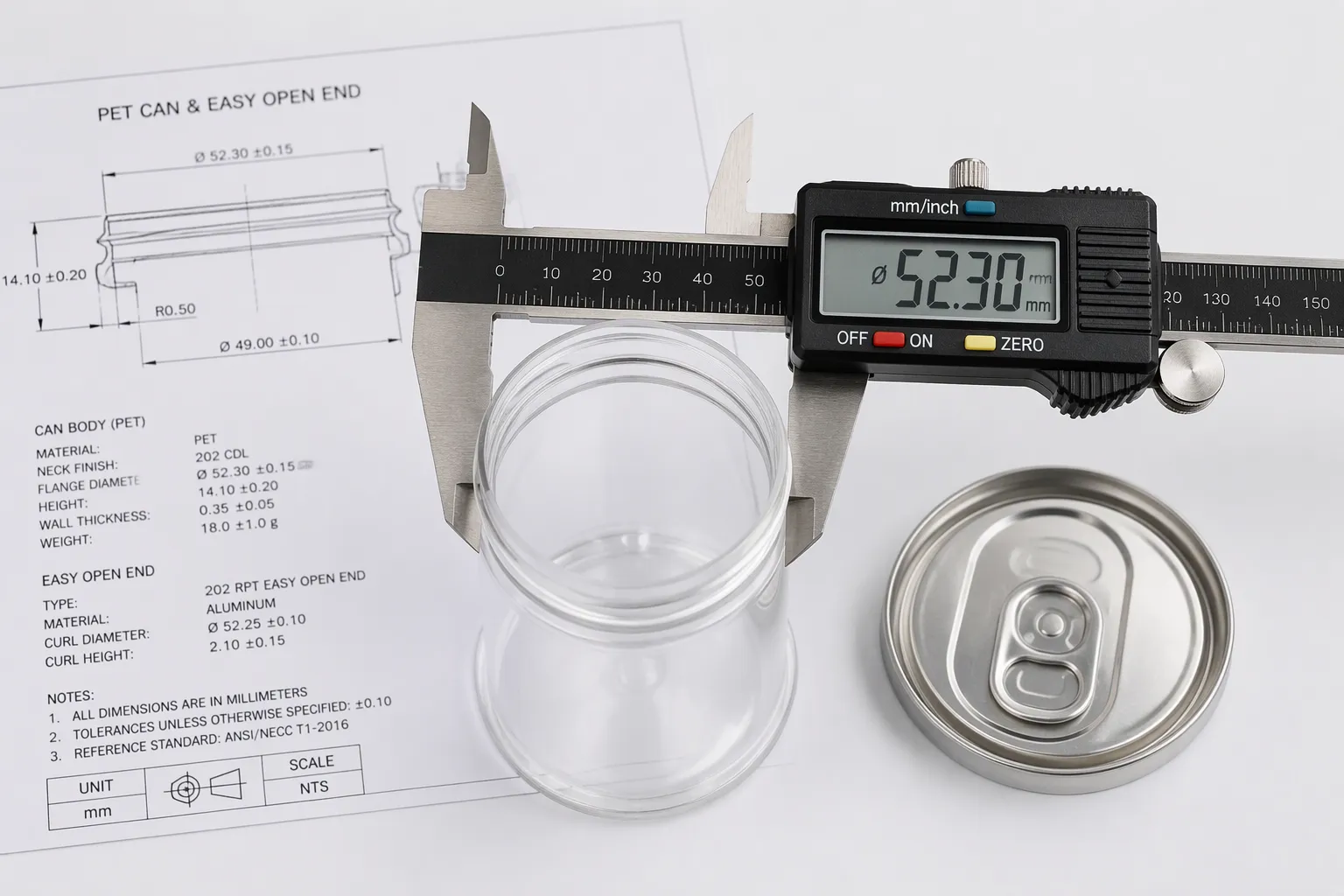
Nominal diameter labels do not prove pet can lid compatibility. Two pet cans with the same volume can carry different neck openings. Matching starts with the neck diameter, not the fill volume. Request the detailed can body drawing first. Skipping this step often means ordering lids that never seal.
Can Body Drawing Details
The drawing should list body diameter, flange diameter and thickness, opening inner diameter, neck finish, wall thickness, and material grade. Confirm the can body diameter against the neck opening, because the flange carries the seal. A narrow or uneven flange gives the easy open end nothing to grip. The can body must also hold pressure. Food-grade PET resin meeting FDA and EFSA standards supports this. Compatible pet cans share one trait: the flange geometry matches the approved drawing revision. Most cans in a product line share one neck finish. Ask for that revision number in writing. Run a pet can lid compatibility check on the drawing itself. Compare the neck finish callout with the pet can lid you plan to buy. A pet can lid that fits one neck finish may not fit another, so confirm pet can lid compatibility twice.
Easy Open End Compatibility
The easy open end needs its own approved drawing. Check the end profile, curl dimensions, countersink depth and radius, rivet and score specifications, and tolerances. Special styles such as the 360 End need different tooling. Flag them early. This rule applies to every easy open end style. Easy open end compatibility depends on the curl meeting the flange. Dimensional incompatibility between the easy open end and the can body is one of the most common causes of sealing problems. Small deviations in end diameter, curl geometry, or flange dimensions can change the seam structure. Leakage, contamination risk, and shorter shelf life can follow. Record each end specification for pet can lids on the order. A vague end specification invites the wrong shipment. Send the end drawing with the easy open end inquiry.
A mismatch between body flange and end curl can produce droop:
- Weak structural points may form.
- These points may rupture under internal pressure or thermal stress.
Cross-check the end curl against the can body flange. Confirm the pair as a matched set. Order the can body and matching end together, for example a PET body with an aluminium easy-open end. Treat the container and its matching end as one unit. This step protects pet can lids from arriving with a corresponding end size that does not fit. It also keeps easy-open aluminium can ends and aluminium easy-open ends on the same revision as the can. Lids from a different revision may look identical and still fail. Order lids and bodies together. Inspect incoming ends against it.
Seaming Equipment and Trial Run
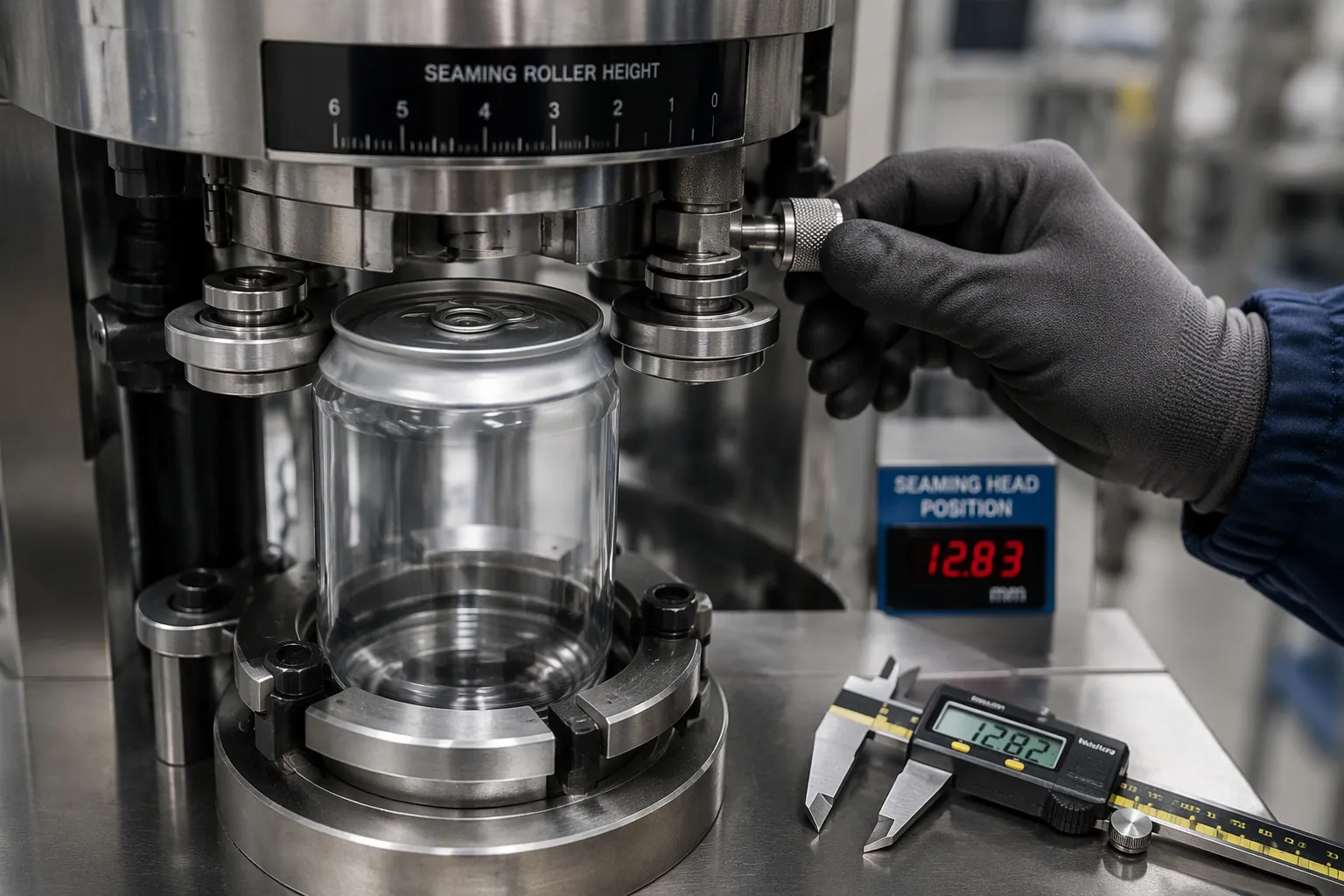
The seamer, chuck, and rollers must be confirmed against the specific can body and end combination. Order the can and matching end as a matched pair, for example a PET body with an aluminum easy-open end. A seaming machine set for aluminum cans will not close a pet can correctly without tooling changes.
Machine and Tooling Match
Confirm the chuck profile, first and second operation roller profiles, seaming cam settings, and base plate height with the equipment supplier. The first operation forms the body hook and cover hook relationship. The second operation compresses and finishes that structure. A poor first-operation seam cannot be repaired by adding second-operation compression. The table below shows how each adjustment affects seam quality.
| Adjustment | Setting Condition | Effect on Seam Quality |
|---|---|---|
| First-operation roller pressure | Too far back | Hooks do not interlock; overlap drops below the minimum threshold (typically under 45%) |
| First-operation roller pressure | Too close | Crushes the softer PET flange; stress-whitening or a cut flange causes immediate failure |
| Second-operation compression | Excessive | Flange buckling, lip deformation, or cutover |
| Second-operation compression | Insufficient | Compound not fully squeezed; gas escapes past the plastic-to-metal boundary |
| Base-plate pressure | Reduced 15%–25% | Lifts the can without vertical neck compression |
| Roller clearance | Wider than aluminum | Accommodates the thicker plastic flange |
Trial Seam Inspection
Run the trial in a fixed sequence. Pull seam samples, inspect them visually, then measure seam thickness, width, overlap, and countersink. Follow with a teardown inspection. Finish with opening performance tests: pull force, opening cleanliness, and score behavior, all against criteria agreed in advance. Share filling and processing conditions with suppliers before the trial so the seam is validated under realistic conditions. Provide the product type and formulation, carbonation or pulp content, fill temperature, headspace and vacuum targets, and hot-fill, pasteurization, or retort conditions. These details separate three questions: whether the container can be handled, whether the product can be filled, and whether the closure meets approved seal integrity criteria. Under 21 CFR 113.60, closure observations must continue during production, with a randomly selected can examined from each seaming head and extra checks after a jam, adjustment, or prolonged shutdown.
Order Checklist for PET Can Lids and Bodies
Information to Send Suppliers
A complete information package prevents most order errors. Send the can body drawing with its drawing number and revision. Add the easy open end drawing, the seaming machine make and model, and the tooling details.
| Item to Send | Why It Matters |
|---|---|
| Can body drawing | Confirms flange and neck geometry |
| Easy open end drawing | Defines curl and countersink |
| Seaming machine details | Confirms tooling compatibility |
| Tooling details | Matches chuck and rollers |
| Filling conditions | Validates the seam under real use |
Select pet can lids, bases, and closures together as one system. Match the lid choice to the product application. Different types of pet can lids suit different fill methods and pressures. Confirm pet can lid compatibility across the whole set before ordering.
Record Confirmations
Build one order confirmation record. It should hold approved drawings, trial results, setup parameters, and inspection criteria. This record becomes the reference for incoming inspection and repeat orders. Give it a header line with part number, revision, date, and approver. Link it to the purchase order.
Ask for measured values, not tick marks. A result near the top of its tolerance tells you more than a pass mark. A first article is valid only for the process that made it. Request a new or partial first article when the drawing revision changes, a tool is repaired or moved, or the material grade changes. Keep every pet can lid record current.
Compatibility comes from approved drawings and a trial run. Nominal sizes and volume prove nothing. Open technical talks with suppliers early, before production and before ordering. Keep the checklist and trial records on file. A short trial run and a complete information package cost far less than a mismatched pet can order. Every pet can order deserves that proof.
FAQ
Does one easy-open end fit every PET can size?
No. End fit depends on neck finish and flange geometry, not fill volume. Cans from 150ml to 1000ml may share one neck, but confirm the drawing revision for each size.
What should I request before placing a first order?
Ask for the can body drawing, the end drawing, and tooling details for your seamer. Request free samples and a trial seam report against agreed criteria.
How long does a trial run and delivery take?
Trial timing depends on your seamer and product conditions. Plan production around the stated 20–30 day delivery window and schedule the trial before the order releases.
Post time: Nov-26-2026