


In the fast-moving beverage sector, packaging is the silent salesman. For decades, the PET Cup (thermoformed cup with a dome lid or sealing film) has been the ubiquitous standard for bubble tea shops, juice bars, and coffee houses. It was cheap, accessible, and functional enough for immediate consumption.
But “functional enough” is no longer enough.
As the lines between Food Service (restaurants/cafes) and CPG (Consumer Packaged Goods) continue to blur, a new contender has emerged to challenge the status quo: the PET Can.
At COPAK, we are witnessing a massive migration. Brands are not just switching packaging; they are upgrading their entire business model. By analyzing technical data, logistics, and consumer psychology, this comprehensive guide will explain why the PET Can is superior to the PET Cup in every metric that matters to your bottom line.
1. The Seal Integrity: From “Spill-Proof” to “Hermetic”
The most immediate difference lies in how the container is closed. This isn’t just about preventing spills; it’s about physics.
The PET Cup: A Flawed Barrier
PET cups typically rely on two sealing methods:
·Snap-on Lids: These are notorious for popping off if the cup is squeezed or dropped. They offer zero protection against oxidation.
·Heat-Seal Film: While better than a lid, the film seal is fragile. It relies on a thin layer of adhesive. Under pressure (like squeezing a delivery bag), the film can delaminate. Crucially, films are gas-permeable. They allow oxygen to slowly seep in, degrading your beverage’s color and taste within hours.
The PET Can: Industrial-Grade Security
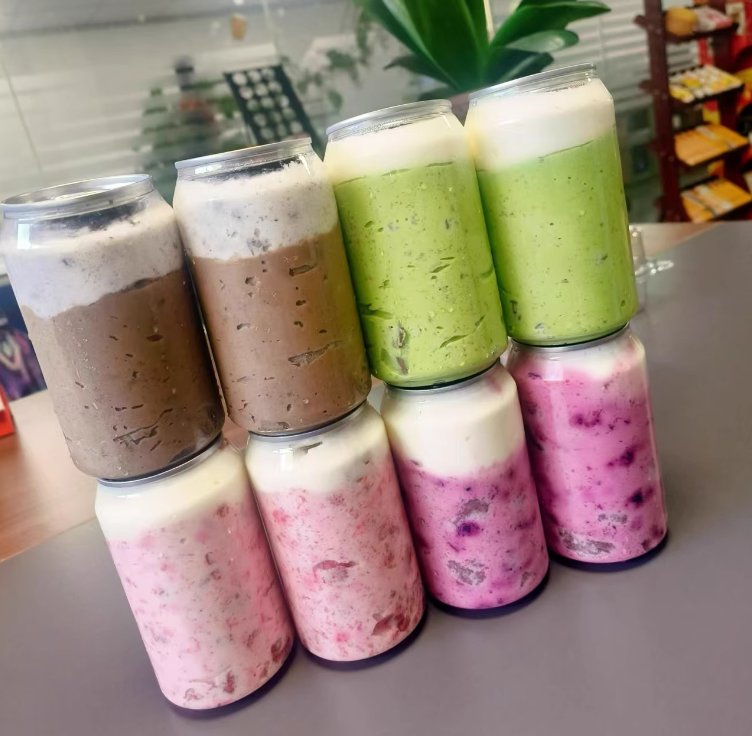
The PET Can utilizes Double Seam Technology—the same standard used by multinational soda giants.
- The Mechanics: The aluminum Easy-Open End (EOE) is not glued; it is mechanically folded and interlocked with the PET flange. This creates a hermetic seal (airtight).
- The Gas Barrier: This seal is impervious to oxygen ingress and carbon dioxide egress.
- Why It Matters: This allows you to sell carbonated drinks. You simply cannot put sparkling water or nitro-infused coffee in a standard PET cup; it will explode. The PET Can handles internal pressures up to 90 PSI, unlocking an entire category of fizzy beverages for your menu.
2. The Business Model Shift: Breaking the “3-Kilometer Radius”
This is the most critical “incremental value” that most packaging suppliers fail to mention. The choice of packaging dictates your Total Addressable Market (TAM).
The Cup Trap: Hyper-Local Limits
If you package in a cup, you are tethered to the “Scooter Radius.” You can only sell to customers who can be reached by a delivery driver within 30 minutes before the ice melts or the seal breaks.
- Constraint: You are running a service business. To grow, you must invest in high-rent physical locations.
The Can Revolution: The E-commerce Unlock
The PET Can transforms your product from a perishable service item into a shippable commodity.
- Logistics Ready: Because of the rigid body and hermetic seal, PET Cans can be packed in cardboard boxes and shipped via FedEx, UPS, or standard courier services without fear of breakage or leakage.
- The Opportunity: Suddenly, a local Kombucha brewer in Seattle can sell to a customer in New York. You can list your products on Amazon, TikTok Shop, or your own website.
- Strategy: Switching to PET Cans allows you to adopt a DTC (Direct-to-Consumer) strategy, scaling revenue without the heavy CAPEX of opening new brick-and-mortar stores.
3. Shelf Life & Operational Efficiency: The “Batching” Advantage
For shop owners, labor costs and food waste are the enemies. PET Cups exacerbate these problems; PET Cans solve them.
The “Made-to-Order” Bottleneck (Cups)
In a cup model, every drink must be made on-demand.
The Peak Hour Crisis: When 50 orders come in at lunch, your staff is overwhelmed. Customers wait, quality drops, and mistakes happen.
Spoilage: You cannot pre-make drinks in cups 3 days in advance. If you prep too much, it spoils by the end of the day.
The “Production Run” Model (Cans)
Because PET Cans (especially when combined with cold-chain logistics) can extend shelf life to 7–14 days (for fresh fresh) or even months (with HPP or preservatives), you can decouple production from sales.
Batching: Your staff can produce 500 units of Cold Brew Coffee on a slow Monday morning. These are stored in the fridge.
Speed: When the Friday rush hits, staff simply grab a pre-made, sealed can. Service time drops from 3 minutes to 10 seconds.
Result: You flatten your labor curve, reduce stress, and virtually eliminate spoilage waste.
4. Consumer Psychology: The “Premium” Perception
Why can you charge $6.00 for a drink in a can, but only $4.50 for the same drink in a cup? The answer lies in Perceived Value.
The “Disposable” Stigma of Cups: Thin-walled plastic cups are associated with fast food, slushies, and quick consumption. They feel temporary and cheap.
The “Retail” Authority of Cans:
Tactile Quality: Our PET Cans are produced using Injection Stretch Blow Molding (ISBM), creating a rigid, glass-like wall. It feels solid and substantial in the hand, not squishy.
The “Pop” Sound: The auditory cue of cracking open an aluminum lid triggers a psychological response of “freshness” and “safety.”
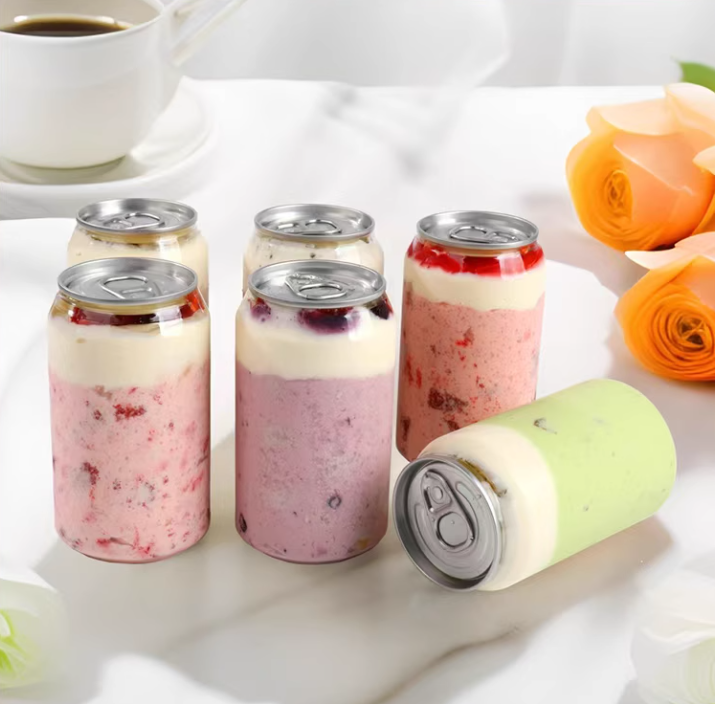
Visual Contrast: The juxtaposition of the industrial metal lid with the crystal-clear body creates a modern, high-end aesthetic that is highly “Instagrammable.”
Data Point: Market research suggests that premium packaging can justify a price increase of 15-20% while simultaneously increasing customer satisfaction scores.
5. Marketing & Customization: A 360-Degree Billboard
Cup Limitations
Printing on cups is difficult. You usually rely on a small sticker or a generic logo. Custom printing requires massive Minimum Order Quantities (MOQs) of 50,000+ units, which is a barrier for small brands.
Can Versatility
PET Cans offer superior branding real estate.
·Labels: You can apply full-wrap shrink sleeves, pressure-sensitive labels, or even clear stickers to achieve a “no-label” look.
·Flexibility: Because the can is a standard cylinder, labeling machines are cheap and easy to use.
·Low MOQ Customization: At COPAK, we support small and medium brands. We can produce custom-colored PET cans or emboss your logo directly onto the plastic body, offering a level of bespoke design that generic cups cannot match.
6. Environmental Reality: The Circular Economy
Competitors often gloss over this, but the environmental narrative is crucial.
·Material Uniformity: Many cups use mixed plastics (e.g., a PET cup with a PP lid and a straw). This complicates recycling.
·The PET Can Advantage: Our cans are made from 100% PET—the most recycled plastic in the world. The aluminum lid is easily separated during the recycling process (sink-float tank method).
·rPET Capability: We offer the option to manufacture cans using Recycled PET (rPET) content. This allows your brand to claim a reduced carbon footprint, appealing to eco-conscious Gen Z consumers.
Summary: The Feature-Benefit Matrix
To summarize why the PET Can is the superior choice, we have compiled this direct comparison:
|
Feature |
Standard PET Cup |
COPAK PET Can |
The Business Impact |
| Sealing | Heat Seal Film / Snap Lid | Hermetic Aluminum Seam | Enables carbonation; prevents oxidation. |
| Transport | Local Delivery Only | Nationwide Shipping | Expands market from 5km to Global. |
| Shelf Life | Hours / 1-2 Days | 7 Days – 12 Months | Reduces waste; enables batch production. |
| Durability | Flexible / Crushes | Rigid / Impact Resistant | Zero breakage in transit. |
| Pressure | 0 PSI | Up to 90 PSI | Allows for sparkling drinks & nitro coffee. |
| Perception | “Fast Food” | “Premium Retail” | Justifies higher pricing strategy. |
Conclusion: Upgrade Your Vessel, Upgrade Your Business
The debate between PET Cups and PET Cans is no longer just about preference; it is about survival and growth.
The PET Cup is a relic of the “service economy.” The PET Can is the tool of the “scale economy.” It offers safety, longevity, beauty, and reach that a cup simply cannot provide.
At COPAK, we are more than just manufacturers; we are your transition partners. We offer:
·State-of-the-Art Production: Over 20 automated lines ensuring consistent quality.
·Custom Solutions: From 150ml to 1000ml sizes, with custom mold capabilities.
·Full Support: We guide you through the transition, from choosing the right sealing machine to designing your label.
Stop pouring your potential into a leaky cup. Seal your success with a PET Can.
Post time: Jan-09-2026