



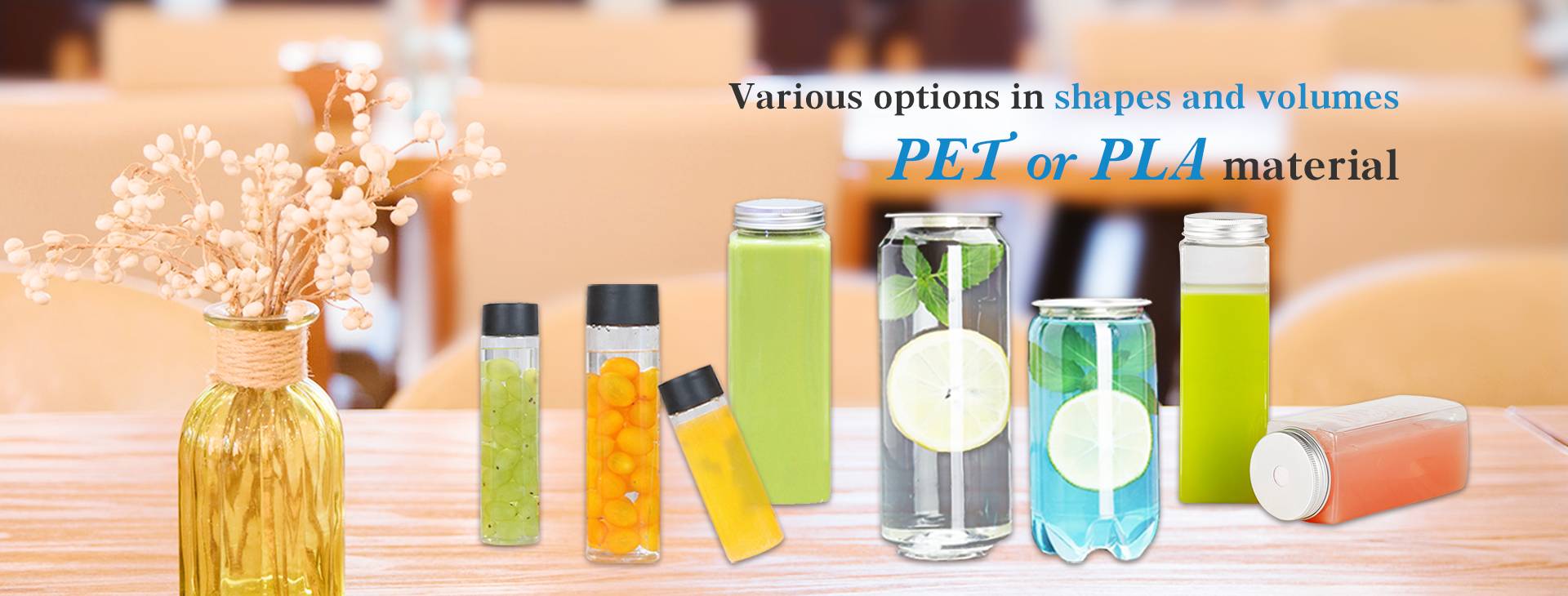
PET Plastic Bottles - China Manufacturer for Global Markets
From our China-based facility, I deliver PET Plastic Bottles that meet the highest standards for safety and performance. As a proud Manufacturer, I offer a wide range of sizes and closures—from 15 ml sample bottles to 1 L family packs—all crafted from food-grade PET and designed for leak-resistance and recyclability. I tailor color, cap types, and printing options to fit your brand, helping you differentiate in crowded markets. Our bottles are light, strong, and compatible with hot-fill and cold-fill processes, reducing freight costs and waste. With efficient MOQs and rapid lead times, I can support your China or global supply chain. Partner with me for consistent quality, transparent pricing, and dependable service that keeps your products on shelves longer. PET Plastic Bottles you can trust, backed by a manufacturer who cares about your business success.

PET Plastic Bottles Supplier Outperforms the Competition
A leading PET plastic bottles supplier is outperforming the competition by combining advanced production technology, rigorous quality control and global compliance to meet the exacting demands of beverage, personal care and pharmaceutical buyers. With high-efficiency blow-molding lines, food-grade materials and multi-point inspection protocols, the supplier consistently delivers bottles that meet tight tolerances, low oxygen and moisture transmission requirements, and aesthetic standards expected on international shelves. What sets this partner apart for global purchasers is a full-service approach: fast prototyping and custom mold capabilities, lightweight and rPET options for circularity, scalable capacity to support both small runs and mass production, and streamlined international logistics that reduce lead time and landed cost. Responsive technical support and flexible commercial terms ensure predictable supply, allowing brands to accelerate time-to-market while maintaining cost and sustainability targets.
| SKU / Type | Capacity (ml) | Avg Weight (g) | Wall Thickness (mm) | Recyclability (%) | Intrinsic Viscosity (IV, dl/g) | Dimensional Tolerance (mm) | Carbon Footprint (kg CO2e / kg) | Lead Time (days) | Improvement vs Industry |
|---|---|---|---|---|---|---|---|---|---|
| Lightweight 500 Designed for minimal material use |
500 | 13 | 0.28 | 99 | 0.78 | ±0.18 | 2.0 | 10 |
Weight: -22%
Lead time: -44%
Carbon: -15%
|
| Standard 500 Balanced strength & material use |
500 | 18 | 0.35 | 99 | 0.75 | ±0.25 | 2.3 | 12 |
Weight: -10%
Lead time: -33%
Carbon: -10%
|
| Sport 750 Ergonomic shape for active use |
750 | 22 | 0.40 | 98 | 0.80 | ±0.20 | 2.2 | 13 |
Weight: -18%
Lead time: -28%
Carbon: -12%
|
| Large 1L Stable base for bulk formats |
1000 | 28 | 0.45 | 98 | 0.82 | ±0.30 | 2.4 | 14 |
Weight: -12%
Lead time: -27%
Carbon: -8%
|
| Mini 250 Ultra-compact, travel-friendly |
250 | 9 | 0.22 | 99 | 0.74 | ±0.15 | 1.8 | 9 |
Weight: -25%
Lead time: -44%
Carbon: -20%
|
| Eco-Barrier 500 Enhanced barrier layer for sensitive liquids |
500 | 20 | 0.38 | 95 | 0.86 | ±0.22 | 2.6 | 15 |
Weight: -5%
Lead time: -20%
Carbon: +2%
|
Related Products


PET Plastic Bottles Leads the Global Market Factory-Direct Excellence
Top Selling Products



- Related Blog
- Reviews
- Reviews
